When investors buy a commercial property, they also buy whatever environmental contamination comes with it, regardless of who put it there and when. They can protect themselves by ordering a Phase I environmental assessment for about $3K. It looks at records, a site walk, and interviews. Ordering it is what buys the protection, and the protection is conditional: afterward they have to live with any restrictions on the site, and they can't make the problem worse.
If Phase I comes back clean, that's the end of it. If it finds what the standard calls a Recognized Environmental Condition, the buyers aren't forced to dig it up and haul it away. They are required to contain it: stop anything still leaking, keep it from spreading, keep people away from it. Ignore that and they lose the defense, and the whole cleanup becomes theirs. So a known problem has to be sized before anyone buys the property. They order a Phase II and sample soil, groundwater and vapor, at three to ten times the cost of the Phase I. At the end of it they understand what's there, how bad it is, and what it costs to fix. Then they decide whether the investment still makes sense.
Environmental cleanup does not mean pristine. Instead, you clean to the standard that the intended use requires. For example, industrial reuse needs less cleanup than a daycare.
(I learned this in a classroom decades ago in my civil/environmental engineering curriculum. I've always wondered when I would use that degree in my data career. It took a while!)
Companies handle their data the opposite way. They commit to AI projects first only to find out what lies beneath halfway in. Nobody has built the equivalent of a Phase I for data, so there is nothing to order and no standard to point at. They discover they have to clean up the data, but they can't see how much that will cost or how long it will take. Fear takes over, because fear of an unbounded problem is rational.
A Phase I for an AI project on proprietary data would be a quick look at whether a company's systems agree, and how far you get before the answers depend on who you ask. A Phase II would go deeper: backward to why they disagree, forward to every decision that has run on the wrong number since. In the case of real estate, the second pass is the expensive one. With data, the digging is what just got five to ten times cheaper.
How much to clean works the same way as environmental remediation. Don't clean all the data, just what's required for the use case in front of you. You clean to industrial, not to daycare. The use case pays for its own cleanup, and it gives the bill an end.
A Phase II's output is not clean data. It is a cost estimate and scope for the cleanup. At that point, you're no longer operating from a position of fear. You're dealing with a defined project, to which you can say yes or no. What would you need to know about your own data before you'd greenlight the project?
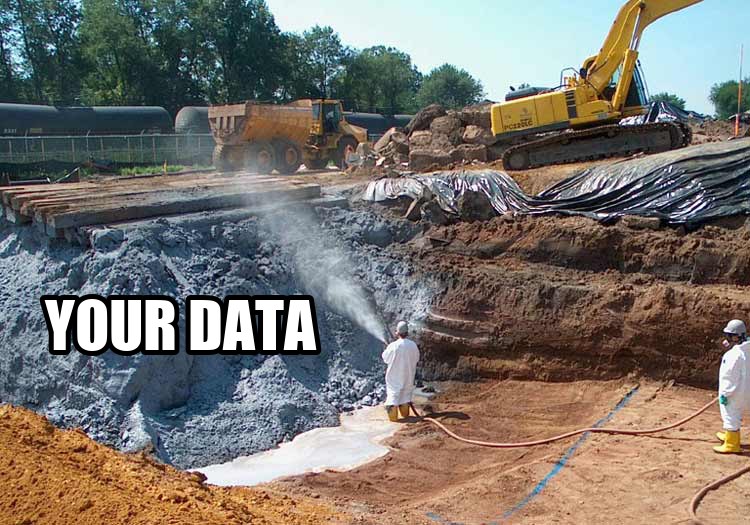
Photo: U.S. Environmental Protection Agency, "Soil excavation and cleanup at a Superfund site," from the Superfund cleanup process page. The "YOUR DATA" caption is mine.