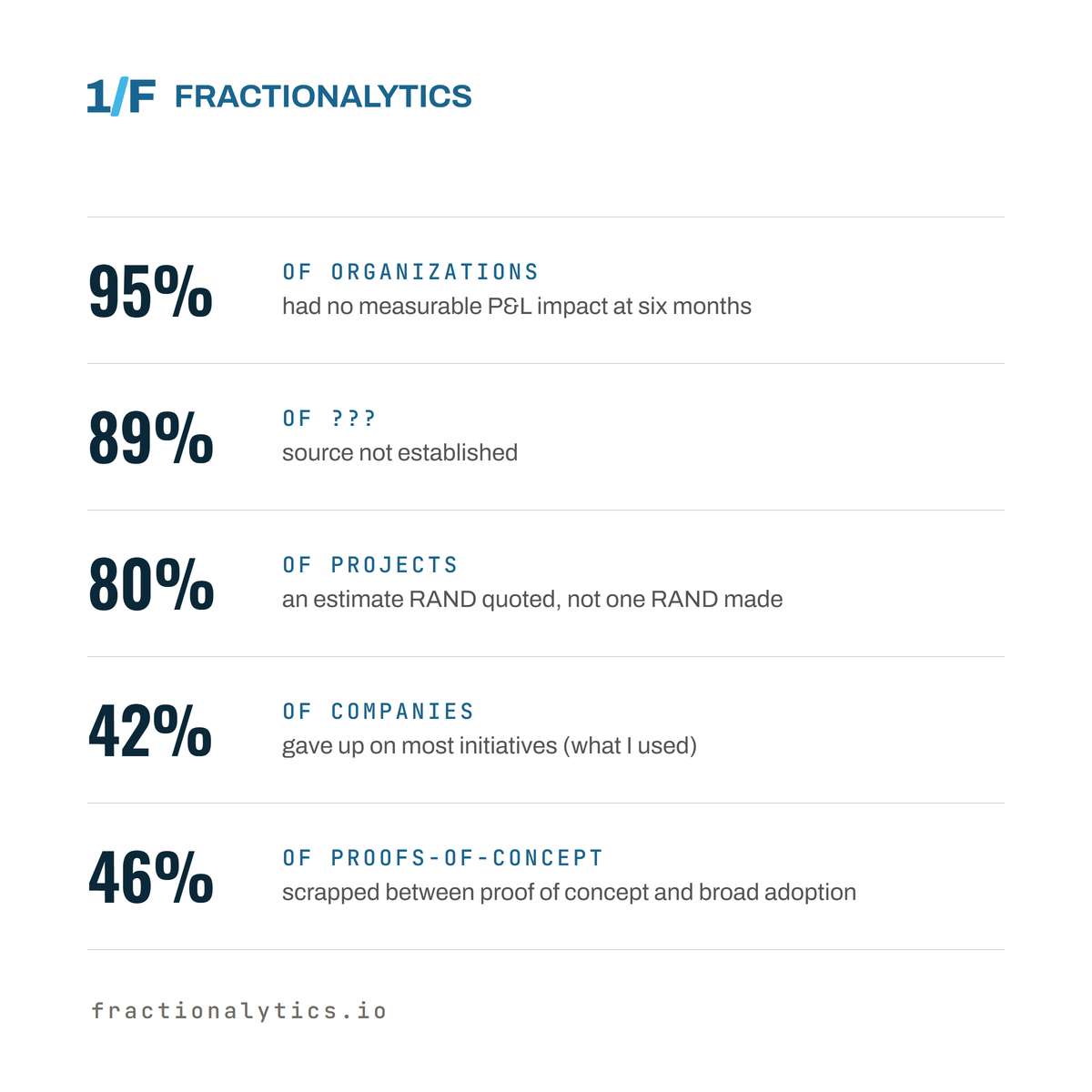
I have a confession to make. I quoted "42%" in a post back in July, and used it as the hero image.
"S&P Global surveyed more than a thousand enterprises across North America and Europe and found that 42 percent of them walked away from most of their AI initiatives in 2025, up from 17 percent the year before."
When I first went back to find the source, I couldn't get to it. The report sits behind a paywall, the figures were corroborated across several outlets, and the best I had was a trade write-up.
Then I eventually found the free S&P Global page, published May 30, 2025. It says the survey was 1,006 midlevel and senior professionals, not "more than a thousand enterprises," and it describes the change as year over year, not 2025. Three things wrong in one sentence I published under my own name.
So I went looking for corroboration from other sources. Surely somebody else has run a similar survey.
One of the most quoted is RAND, 2024: "By some estimates, more than 80% of AI projects fail." That's an estimate they inherited, and their footnote points at a 2022 Fortune interview with a CEO. RAND's own work was 65 interviews about root causes, not a failure rate count.
The 89% is the one I couldn't source at all. Every write-up that carries it credits somebody else, and they don't agree: some say Deloitte, some Gartner, one Gartner and IDC, one Mayfield.
Deloitte's Tech Trends 2026 says 11% of organizations have agents in production and 38% are piloting. It doesn't say 89%, on any of the seven Deloitte reports and pages I searched. The 89 looks like somebody's subtraction from that 11. I can't find the step or who took it.
Here's the part that really bothers me: I asked Opus 5 to trace it. Its searches kept returning AI-written summaries asserting Deloitte and 89%, and one explained it as the leftover: the other 89% have written the investment off. That is a number warping in front of me. A status about scaling, restated as money lost. The model caught it only because I made it read the primary documents.
I don't believe any of these numbers is a lie or some grand conspiracy. Each is right under its own definition. The fight isn't over who is truthful. It's over which definition governs a decision.
All of that was public data I could go and read, and it still took hours. Inside a company you can't. Nobody publishes the definition of a customer, or an active account, or revenue this quarter. Two systems hold two answers, finance brings one to the meeting and growth brings another, and the argument runs on whoever is most confident. That is the version I work on a lot.
Which is why pointing an agent at it makes things worse first. A person who gets a number they don't trust asks where it came from. An agent takes it and keeps going.
Ask for the document, not the statistic. If nothing comes back that contains the number, you don't have a number.
Which of these numbers is your leadership using, and does anybody there know what it counted?
Sources
From the first comment on the LinkedIn original, in the order they appear:
- S&P Global Market Intelligence, May 30, 2025, 1,006 professionals in North America and Europe (the 42% and the 46%).
- CIO Dive's write-up, which is where I started.
- RAND, 2024, "The Root Causes of Failure for AI Projects and How They Can Succeed." The 80% is on page 1 and its footnote points at Jeremy Kahn, Fortune, July 26, 2022.
- Deloitte, Tech Trends 2026, for the 11% in production and the 38% piloting.
- MIT NANDA, "The GenAI Divide: State of AI in Business," July 2025, for the 95%. It is labeled Preliminary Findings, it covers generative AI only, and it sits behind a form, so I have no link to give you.